
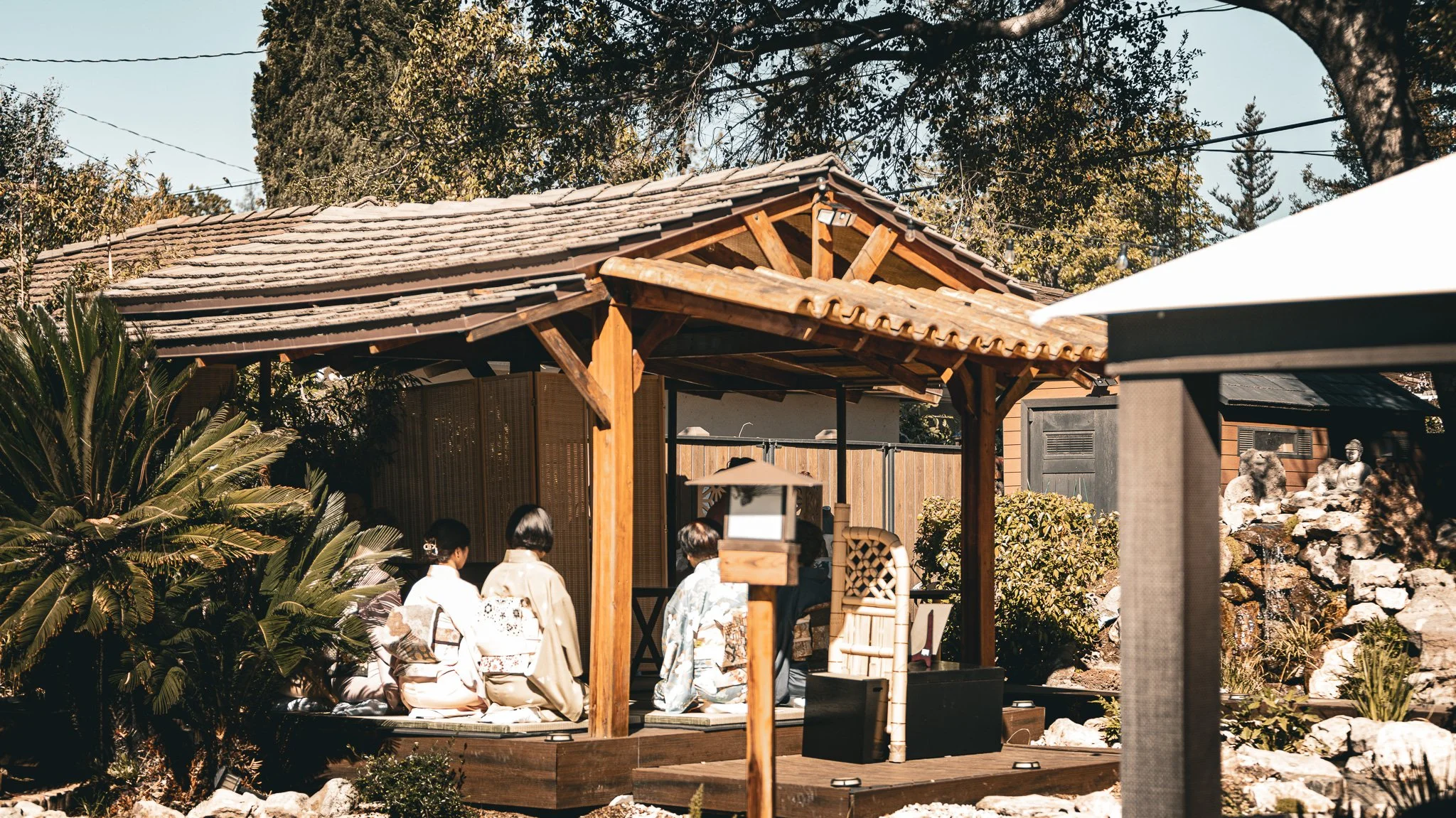
These are the women I gather with at my friend’s tea house, a place where we come together in quiet harmony.
There is a saying in the Way of Tea:
“Every encounter is a once-in-a-lifetime moment.”
Even if we see the same people every day, the moment itself never repeats. The light is slightly different, our hearts are in a different place, and the air holds a new story.
When I step into the tea room, everything slows down. The sound of the kettle, the warmth of the bowl, the careful movements, they all remind me that presence is not something we stumble into. It is something we choose. And I have learned that this same choice shapes the quality of every conversation I interpret.
In the tea ceremony, nothing is rushed.
But nothing is wasted, either.
Every gesture holds meaning because it is done with intention.
Communication is the same.
Interpretation is not just transferring words from one language to another. It is meeting two people, two histories, two cultures, two emotions, and helping them understand each other in a shared moment. Often, the meaning lies not in what is said, but in what is meant.
Tea has taught me to listen for the unsaid.
A slight pause.
A softer tone.
A hesitation before a difficult truth.
A polite phrase that, in one culture, means agreement… and in another means discomfort.
In the tea room, silence is not empty. It is part of the dialogue.
In communication, silence works the same way.
The Way of Tea also teaches humility.
No matter how many years I practice, I never “master” it.
Instead, I return to the basics, posture, breath, gratitude, again and again.
This has shaped the way I approach language. Even after decades of speaking Korean, English, Japanese, and Mandarin, I still learn something new every day. A better expression. A more compassionate tone. A way of speaking that honors the other person more deeply.
When I interpret, I try to carry the same spirit that I carry into the tea room:
Be fully present.
Be responsible for the moment.
Honor the person in front of you.
Tea reminds me that communication is not a transaction.
It is a shared human experience.
And just like tea, good communication requires warmth, patience, respect, and the quiet courage to be attentive.
So whether I am pouring tea in a quiet room…
or interpreting a conversation across languages…
my heart is the same.
Create space.
Create understanding.
Create connection.
Because every encounter, no matter how brief, is truly once in a lifetime.
