
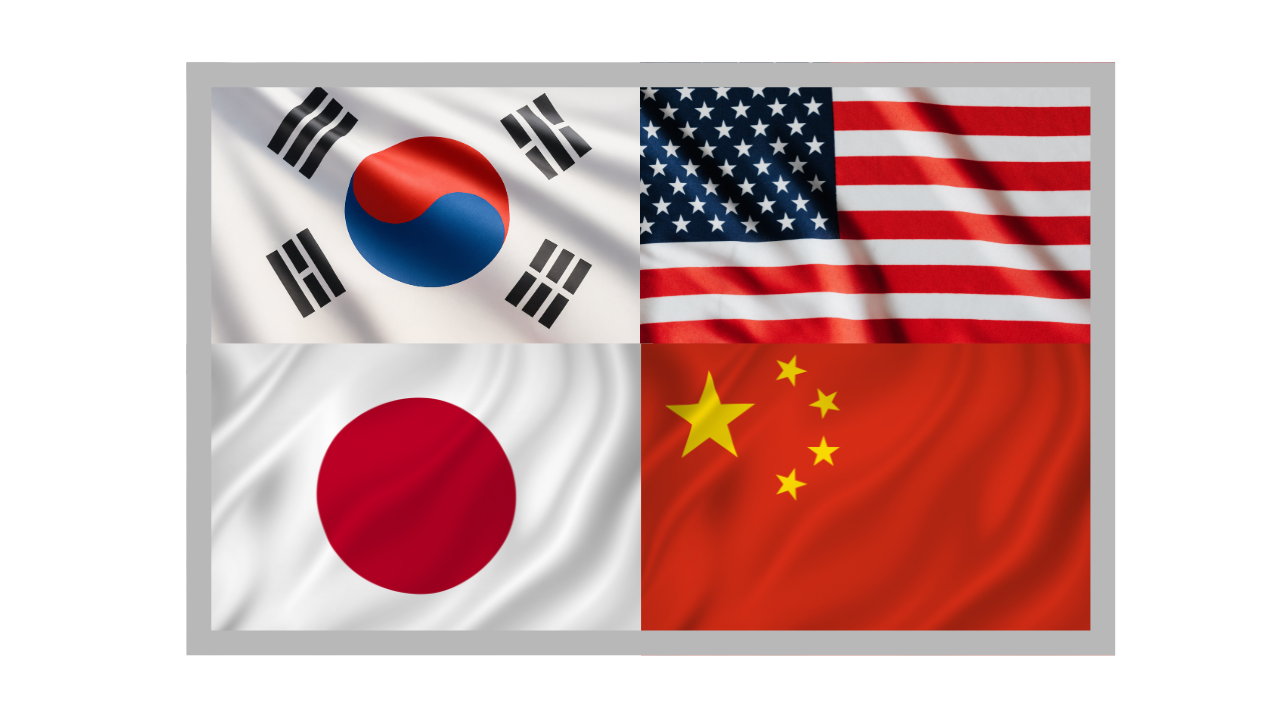
This image brings together the flags of Korea, Japan, China, and the United States, four cultures whose communication styles shape how I listen, interpret, and understand meaning across languages.
Growing up between cultures means you learn early that the same sentence can carry completely different meanings depending on the country, the relationship, and even the moment. Korean, Japanese, and Chinese communication styles share history and values, yet each expresses emotion, respect, and intention in its own distinct way.
Even when the words sound similar, the feeling behind them can be completely different.
These are not rules I memorized from a book.
They are patterns I’ve watched, lived, and learned, sometimes the easy way, sometimes the awkward way.
And they continue to shape the way I listen and interpret today.
🇰🇷 Korean Communication: Warmth Beneath Formality
Korean communication has a softness wrapped in politeness.
People often speak with emotional honesty, but not always directly.
You can feel warmth even in a formal sentence, and you can feel distance even when the words sound polite.
Hierarchy matters, age, relationship, social roles.
So the listener must pay attention not only to what is said, but how it is delivered:
A long pause might mean disagreement.
A gentle “maybe” often means “no.”
A compliment might hide a deeper worry or a wish to connect.
Korean communication is warm, relational, and emotional at its core.
People listen with the heart as much as with the ears.
🇯🇵 Japanese Communication: Harmony Above Everything
Japanese communication values harmony so strongly that meaning often lives in the space between words.
Politeness is a way of protecting both people in the conversation.
You rarely hear a strong “yes” or “no.”
Instead, you hear intention.
“I will consider it” might mean “This will be difficult.”
Silence might be disagreement, or deep respect.
A soft smile can express gratitude, apology, or quiet understanding.
Japan teaches you to observe gently, without forcing meaning.
Communication is a dance of subtlety, timing, and shared awareness.
To listen well in Japanese is to be patient enough to let the other person reveal the truth at their own pace.
🇨🇳 Chinese Communication: Direct, Practical, Yet Deeply Contextual
Chinese communication often carries a different kind of clarity.
People tend to speak more directly than in Korean or Japanese settings, especially in practical conversations or business situations.
But it’s not just straightforwardness; it’s context-driven.
If the relationship is close, speech becomes warm, humorous, open.
If the relationship is new, communication becomes formal and efficient.
Compliments may be modestly deflected, but sincerity is usually clear.
There is directness, yes, but also a strong awareness of relationships and group dynamics.
Emotion is expressed honestly, but timing still matters.
Chinese communication feels lively, sincere, and rooted in connection through shared experience.
🌿 Where the Three Meet — and Where They Differ
Spoken side by side, these languages sound like cousins.
But emotionally, they behave like three different seasons:
Korean feels like late autumn - warm, heartfelt, thoughtful.
Japanese feels like winter - calm, quiet, intentional.
Chinese feels like spring - lively, direct, full of movement.
And yet they overlap in important ways:
Respect for elders
Attention to context
Care in choosing the right expression
A shared understanding that words carry moral weight
These subtle differences are what make interpretation meaningful and beautiful.
To interpret across these cultures is to balance not only words, but histories, values, and human emotion.
It requires listening not just to the speaker, but to the culture that shaped their voice.
🌸 Why These Nuances Matter
In cross-cultural conversations, misunderstanding rarely happens because someone used the wrong word.
It happens because the rhythm, tone, or intention didn’t cross over.
My work is to help those pieces travel safely.
To soften a phrase in Korean the way it was meant.
To preserve the quiet space in Japanese silence.
To carry the clarity and sincerity of a Chinese response.
Language is not only what we say.
It is how we honor each other.
And each culture has its own beautiful way of doing that.
